Ankle Arthroscopy
Do you suffer from ankle pain or instability? Ankle arthroscopy in Tunisia is a minimally invasive surgical technique that allows accurate diagnosis and treatment of intra-articular lesions. Performed by experienced orthopedic surgeons, it offers rapid recovery and lasting results. With attractive prices starting from €2000, benefit from comprehensive care and a quick return to your activities.
What is ankle arthroscopy?
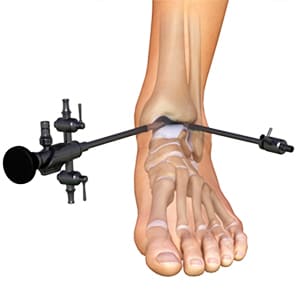 Ankle arthroscopy surgery involves the insertion of small surgical instruments and optical instruments into the ankle joint. Through this method, it is possible to observe the inside of the joint and treat various ankle traumas and intra-articular lesions in a less invasive manner. It is used to detect and treat joint conditions or injuries, offering a precise and specific approach to manage ankle problems.
What are the alternatives to this technique?
Alternatives to ankle arthroscopy may include more invasive operations such as arthrodesis, which involves fixing joint surfaces using screws, staples or plates to the joints. This approach is used to treat serious ankle conditions, particularly in cases of advanced arthritis. Arthrodesis is used to maintain joint stability by fusing adjacent bones, which relieves pain and improves joint function in situations where other less invasive treatments are not effective.
Why undergo this procedure?
Ankle arthroscopy is a minimally invasive surgical procedure recommended for treating various ankle traumas and joint lesions. It helps prevent chronic ankle instability, a common long-term complication. Through this technique, the surgeon effectively stabilizes the joint while preserving healthy structures. This approach also reduces the risks of progressive arthritic degradation of the ankle. The results obtained are very promising, both for joint stability and for treating the underlying pathology. Recovery is faster and post-operative effects are less painful than with traditional surgery.
How is it performed?
Ankle arthroscopy is a minimally invasive procedure performed under general or locoregional anesthesia, most often on an outpatient basis. Small incisions allow the introduction of an arthroscope and fine instruments into the joint, thus providing precise visualization on screen. The surgeon can then diagnose and treat internal lesions without widely opening the joint. This approach limits tissue trauma and significantly reduces post-operative pain. It promotes faster recovery and much more discreet scars than with traditional surgery. Patients thus benefit from effective treatment with fewer inconveniences and accelerated return to activity.
Is it painful?
Post-operative pain may occur after ankle arthroscopy, particularly in cold weather. Cold can exacerbate pain, especially when walking. A person operated on in April reported intense pain with every movement. They suffered from algodystrophy, a disease causing persistent pain. Pain after surgery therefore varies from patient to patient. It can be influenced by weather conditions or pre-existing medical problems.
What is the recovery time after?
Recovery after ankle arthroscopy takes about 6 weeks, but the patient can leave the hospital in 1 to 2 days. Following post-operative instructions is crucial, as complete healing can take 3 to 4 months, or even longer in case of complications.
What are the advantages?
Ankle arthroscopy offers multiple important benefits for patients. This minimally invasive procedure reduces damage to surrounding tissues compared to open surgery. It also helps reduce post-operative pain and significantly accelerates the healing process. By providing an accurate diagnosis, it facilitates thorough assessment of joint problems, allowing targeted treatment. Arthroscopy is often performed on an outpatient basis, allowing patients to return home the same day. This approach promotes faster recovery and limits hospital constraints. Finally, the small incisions leave minimal scars, improving the aesthetics of the result. Patients thus benefit from surgery that is both effective and aesthetically satisfying.
Are there associated risks?
Ankle arthroscopy carries certain risks, although rare, that are important to know. These include joint pain, infections, healing difficulties or joint effusion. In exceptional cases, nerve damage may cause localized skin anesthesia. Despite their low frequency, these complications must be taken into account before deciding on the procedure, in order to fully weigh the benefits and disadvantages of the procedure.
What is the price of ankle arthroscopy in Tunisia?
Tunisia offers very competitive prices for ankle arthroscopy, with savings of up to 50% compared to Europe. Our all-inclusive package includes consultation with the orthopedic surgeon, as well as necessary pre-operative examinations. The procedure is performed by arthroscopy, followed by hospitalization in a private room, outpatient or overnight. Post-operative care, medications and a follow-up consultation at 15 days are also covered. The package also includes rehabilitation sessions, essential for good functional recovery. The price starts at €2,000, and a personalized quote is established according to the complexity of each case.
Frequently asked questions about ankle arthroscopy
1Can you walk immediately after ankle arthroscopy?
Walking is possible the day after the procedure, but with crutches to offload the ankle for the first 2 weeks. Returning to walking without assistance is gradual, under the supervision of a physiotherapist, depending on pain and swelling.
2When can you resume driving after ankle arthroscopy?
It is generally advised to wait 2 to 4 weeks after the procedure before resuming driving, when you can perform emergency braking without pain and ankle mobility is sufficient. Medical advice is essential before getting behind the wheel.
3What are the signs of complications after ankle arthroscopy?
Consult quickly if you experience intense and sudden pain, significant swelling, fever (temperature > 38°C), heavy bleeding, redness or discharge at the incisions, or difficulty mobilizing the ankle. These signs may indicate infection, hemorrhage or other complication.
4Can ankle arthroscopy be performed on an outpatient basis?
Yes, ankle arthroscopy is often performed on an outpatient basis (return home the same day) for simple cases. A 24-hour hospitalization may be recommended for more complex procedures or depending on the patient's health status.
5What physical activities are allowed after ankle arthroscopy?
Swimming, stationary cycling and walking on flat ground are generally allowed after 4 to 6 weeks. High-impact sports (running, football, basketball) require 3 to 4 months of rehabilitation before resuming. Medical advice is essential before any resumption.
6How long does ankle arthroscopy surgery take?
The procedure generally lasts between 30 minutes and 1 hour, depending on the complexity of the lesions to be treated (ligament repair, foreign body removal, joint cleaning). The exact duration will be discussed during the pre-operative consultation.
7What is the difference between arthroscopy and open ankle surgery?
Arthroscopy is a minimally invasive technique that uses small incisions (5 to 10 mm) and a camera to visualize and treat the inside of the joint. It offers faster recovery, less pain and more discreet scars than open surgery, which requires a wider incision and longer convalescence.
Why choose Tunisia for ankle arthroscopy?
Tunisian orthopedic surgeons, trained in Europe and Canada, practice minimally invasive techniques allowing rapid recovery and discreet scars, with prices up to 50% cheaper than in Europe. Procedures are scheduled within 1 to 2 weeks, and personalized follow-up is provided before, during and after the operation to guarantee optimal results and a reassuring experience. This combination of expertise, competitive prices and rapid care makes Tunisia a destination of choice for orthopedic surgery.
In conclusion
Ankle arthroscopy is an effective minimally invasive surgical technique for diagnosing and treating intra-articular ankle lesions. In Tunisia, Tunisie Esthetic offers you quality care, performed by experienced orthopedic surgeons, with modern equipment and attractive prices. Do not hesitate to contact us for a personalized quote and an in-depth consultation.